en


Verification is the step that decides whether a withdrawal leaves the cashier or sits waiting. This page sets out what 888starz asks for, when it asks, and what a Malaysian player can prepare in advance. It is a plain-language summary of the operator’s own anti-money-laundering and account rules; the operator’s rules text remains the binding version.
888starz operates under anti-money-laundering obligations, so it has to know who holds an account before money moves in volume. Its rules reserve the right to request identification before any payment, and verification sits at the centre of the account rather than at the edge of it, touching every product on the platform from the sportsbook to the slots lobby.
There are practical reasons too. The operator prohibits third-party payment methods, which means the name on the payment instrument has to be the name on the account. Verification is how that match gets confirmed. It also supports the ban on multiple accounts, the protection of minors, and the checks the operator runs on winnings generated from bonus funds before they are paid out.
The consequence matters most. Under the operator’s rules, withdrawals can be delayed or refused until verification is complete. Nothing is lost, but nothing arrives either.
Keep in mind
Bonuses have their own requirement on top of KYC. The bonus rules ask for completed personal information and an activated phone number before a bonus or gift can be credited.
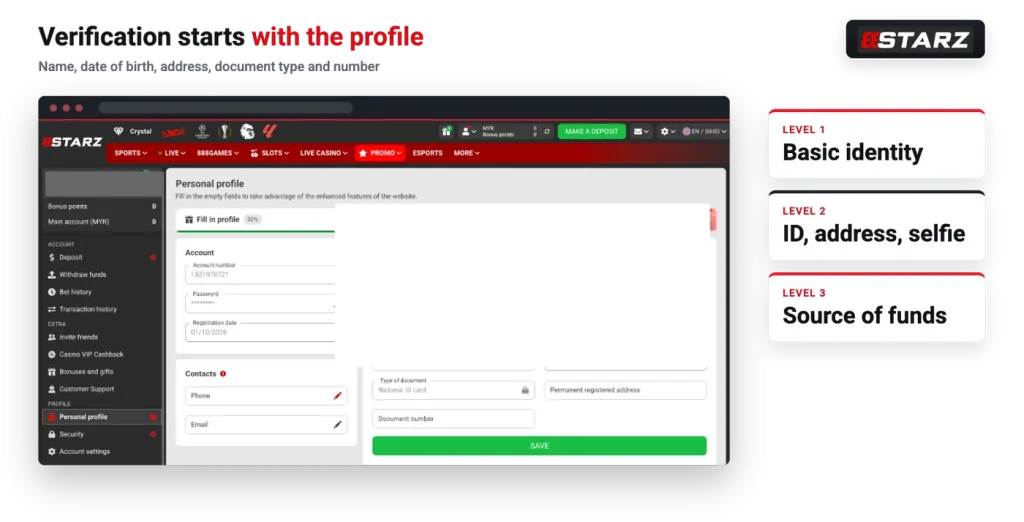
888starz KYC runs in three levels of increasing depth. Most accounts never travel past the first two.
| Level | When it applies | What is asked |
|---|---|---|
| Level 1, basic identity | Before certain services and before withdrawals | Full name, date of birth, nationality, residential address |
| Level 2, standard due diligence | When the operator’s internal thresholds are met | Government-issued photo ID, proof of address, selfie or electronic verification |
| Level 3, enhanced due diligence | Higher-risk cases and large sums | Source of funds or wealth: employment, business activity, investments, inheritance, sale of assets |
Level 1 is largely a profile exercise. The personal profile in the member area already asks for name, date of birth, place of birth, country, region, city, address, document type and number, issue date, phone and email, so filling it in properly at sign-up covers most of it.
Level 2 is where documents are uploaded. Level 3 is the least common and the most demanding, because proving the origin of money takes paperwork a player may not keep to hand: payslips, business records, investment statements, a sale agreement.
The 888starz documents list is short and standard for an online gambling operator:
As a rule, scans fail for dull reasons rather than dramatic ones: a cropped corner, glare across the photo page, an expired document, or an address on the utility bill that does not match the address typed into the profile. Fixing those before uploading saves a second round of review.
Two figures in the operator’s rules deserve attention, because they explain most verification requests.
| Detail | 888starz |
|---|---|
| Verification levels | 3 |
| Cumulative trigger | XCG 4,000, about USD 2,000, in deposits or withdrawals |
| Enhanced check on large winnings | Above EUR 10,000 |
| Can be requested earlier | Yes, identification may be asked before any payment |
Identity verification may be required once cumulative deposits or withdrawals reach roughly USD 2,000, and the rules add that it can be required earlier. So the threshold is a point at which checks become likely, not a shield below which they never happen. A player who deposits in small amounts over several months can still be asked.
The second figure applies to results rather than turnover. Winnings above EUR 10,000 may go through enhanced verification before payout, which in practice means Level 3 territory and questions about source of funds. Caps and thresholds in the operator’s terms are set in euro, while a Malaysian account is held in ringgit, and the cashier shows the amount in MYR.
One more rule shapes the whole process: winnings are paid back through the method used to deposit. That makes your choice of deposit and withdrawal methods a verification decision as much as a convenience one, since the account name and the payment account have to belong to the same person.
With 43 cryptocurrencies in the cashier, including Bitcoin, Ethereum, TRON and USDT across several chains, a good share of accounts fund themselves without a bank. Crypto does not remove the identity question, it moves it. The operator’s rules include wallet ownership verification, so a player using Tether or Litecoin should expect to demonstrate that the sending and receiving wallet is theirs.
Generally, that is simpler with a self-custody wallet than with funds routed through a third party. Coins sent from an address nobody can tie to you are hard to treat as yours, and an operator that prohibits third-party payments has every reason to ask. Keep the same wallet for deposits and withdrawals, and keep access to it.
Verification is predictable, which means it can be front-loaded. A few habits remove most of the friction.
Complete the profile on the day you register rather than on the day you want to cash out. Use your legal name, not a shortened version. Deposit only from an account, card or wallet in that same name, because a mismatch there is the one problem verification cannot solve for you. Check that your ID is still valid before you upload it.
If a bonus is running on the account, remember that requesting a withdrawal while it is active cancels the bonus and its winnings under the operator’s bonus rules. Verification and cash-out timing deserve attention together, and the wider account rules set out how the operator handles complaints and account status.
Finally, the support channels exist for this. The member area offers an online consultant chat, a callback request and a support query form, and a question asked before a document is uploaded is faster than a resubmission afterwards. No withdrawal processing time is published, and the realistic answer is that it depends on the method chosen and on how complete your verification already is.